
The Hotels at the Corner of Tay and Kelvin Streets
Overview
First Hotel on Site: 1862 | Last Hotel on Site Demolished: 2023
Introduction
I began investigating the story of the Scandinavian Hotel on the corner of Tay and Kelvin Streets. This led to a much longer history of the hotels that occupied the site. This article shares only some of the findings, as there appears to be much more of the story to uncover.
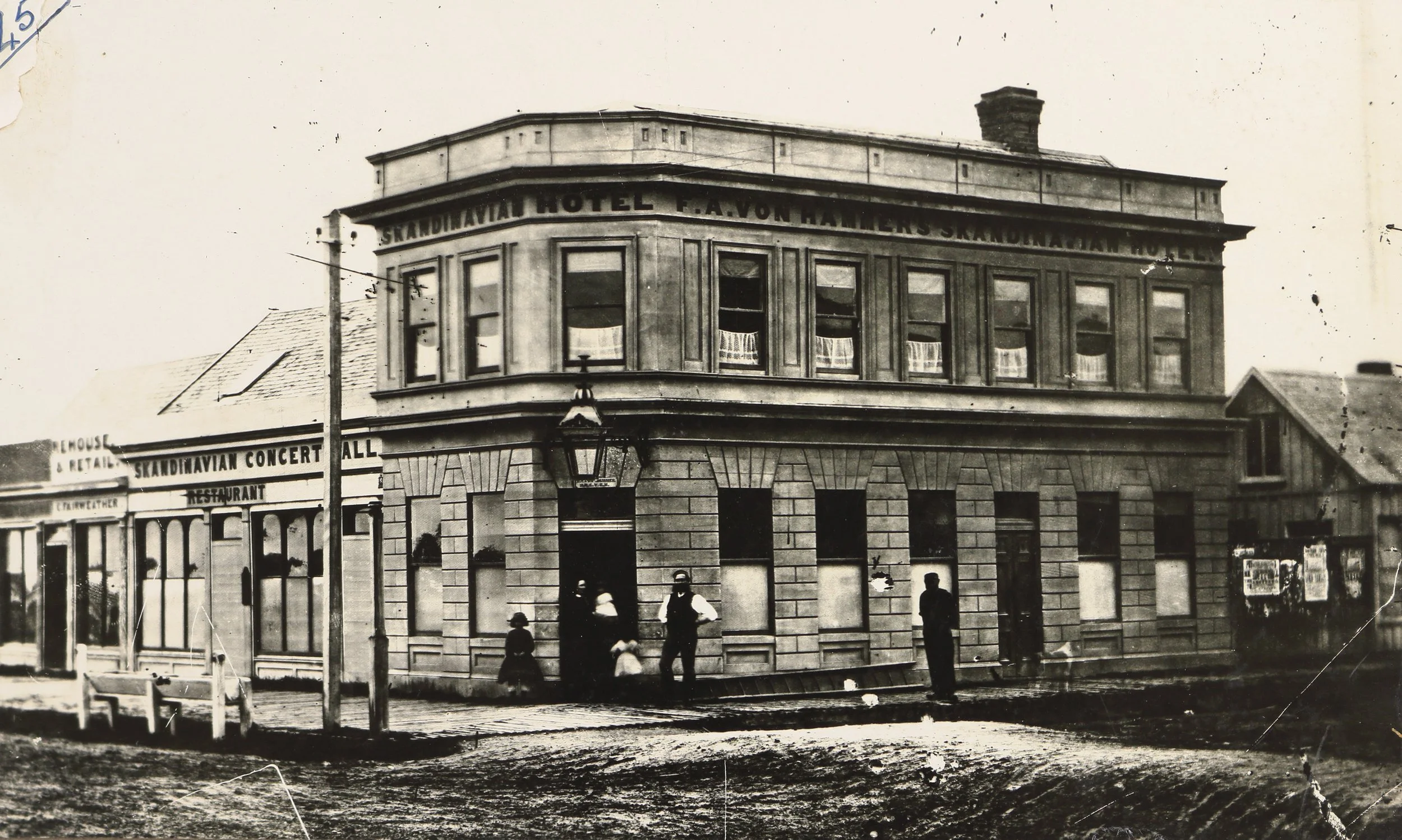
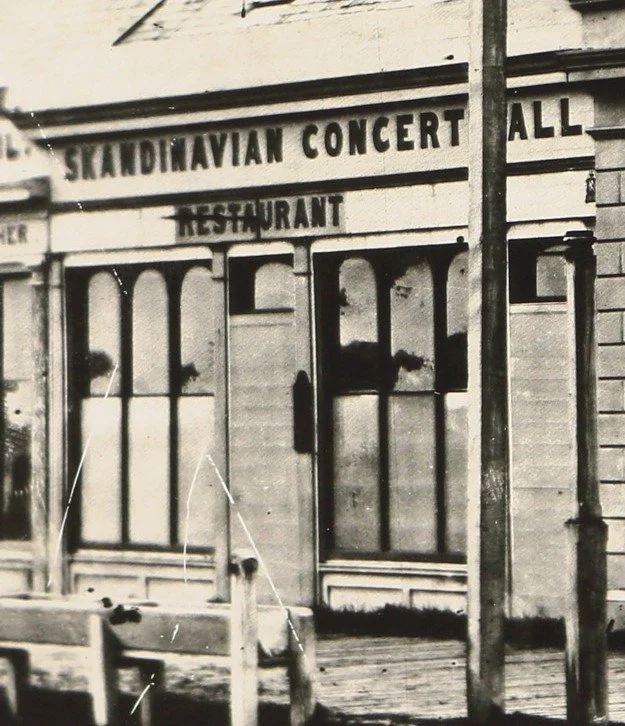
Image: Skandinavian Hotel corner Tay & Kelvin Streets - F.A. Von Hammer opposite Price & Bullieds. c. 1880. Invercargill City Libraries and Archives A0105 S27520001_045
The First Hotel on the Corner
One source states that the first hotel on the site was the Provincial Hotel, erected in 1862 and later known by several names, including the Fire Brigade, Scandinavian, Caledonian and Supreme Court Hotel. However, the surviving sources give different dates for the site’s early history, and some details remain uncertain.
A photograph in Drink or Drought: Liquor Licensing and the Prohibition Movement by A. J. De La Mare shows the same image held by the Invercargill Library. Its caption reads: “The Skandinavian Hotel and Concert Hall, Invercargill, established 1860.” The licence was lost through reduction in 1894.
The earliest evidence I found of what may have been a hotel on the corner dates from about 1863, when advertisements appeared in the Southland Times for F. H. Lee’s Provincial Café. In June 1864, the premises were advertised for sale by private bargain as Lee’s Provincial Hotel and Café, at the corner of Tay and Kelvin Streets. This should not be confused with the Provincial Hotel at the corner of Tay and Conon Streets, owned by August Puettelkow.
The Fire Brigade Hotel and Provincial Café, 1865–1866
Annie Evans was the publican of the Fire Brigade Hotel and Provincial Café.
On 8 June 1866, Ferdinand Augustus von Hammer advertised that he had purchased the premises from Mrs Annie Evans. At that time, the property contained a bar, two bar parlours, a large dining hall, private parlours, a kitchen and sixteen bedrooms, excluding those used by the family.
This was the period of the Wakatipu gold rush, when the goldfields were easier to reach through Invercargill than through Dunedin. During the gold-rush era, the hotel advertised accommodation for 50 boarders at 25 shillings a week and noted that French, Dutch, German, Russian and Scandinavian languages were spoken.
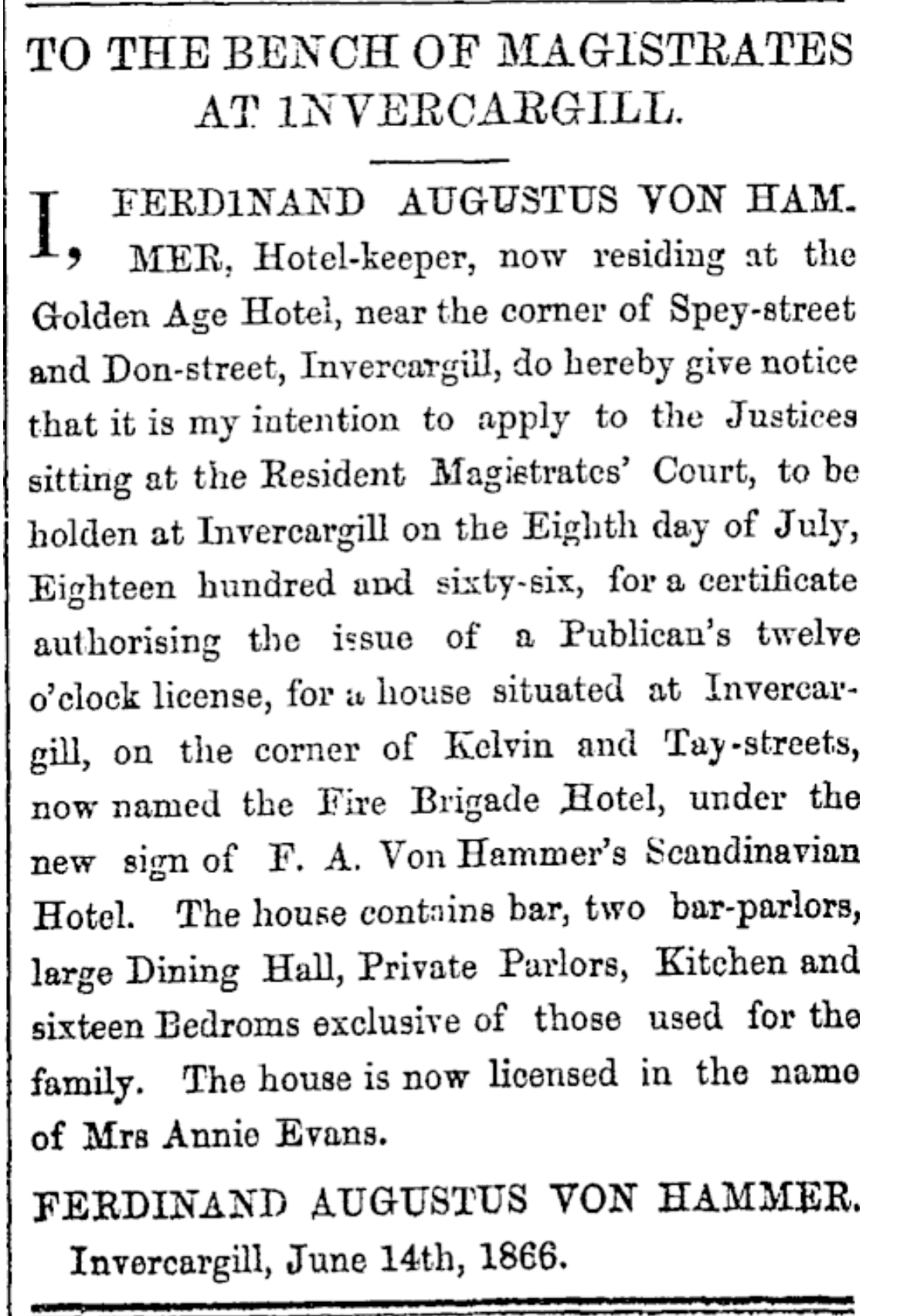
Papers Past; Southland Times, 22 June 1866, Page 1
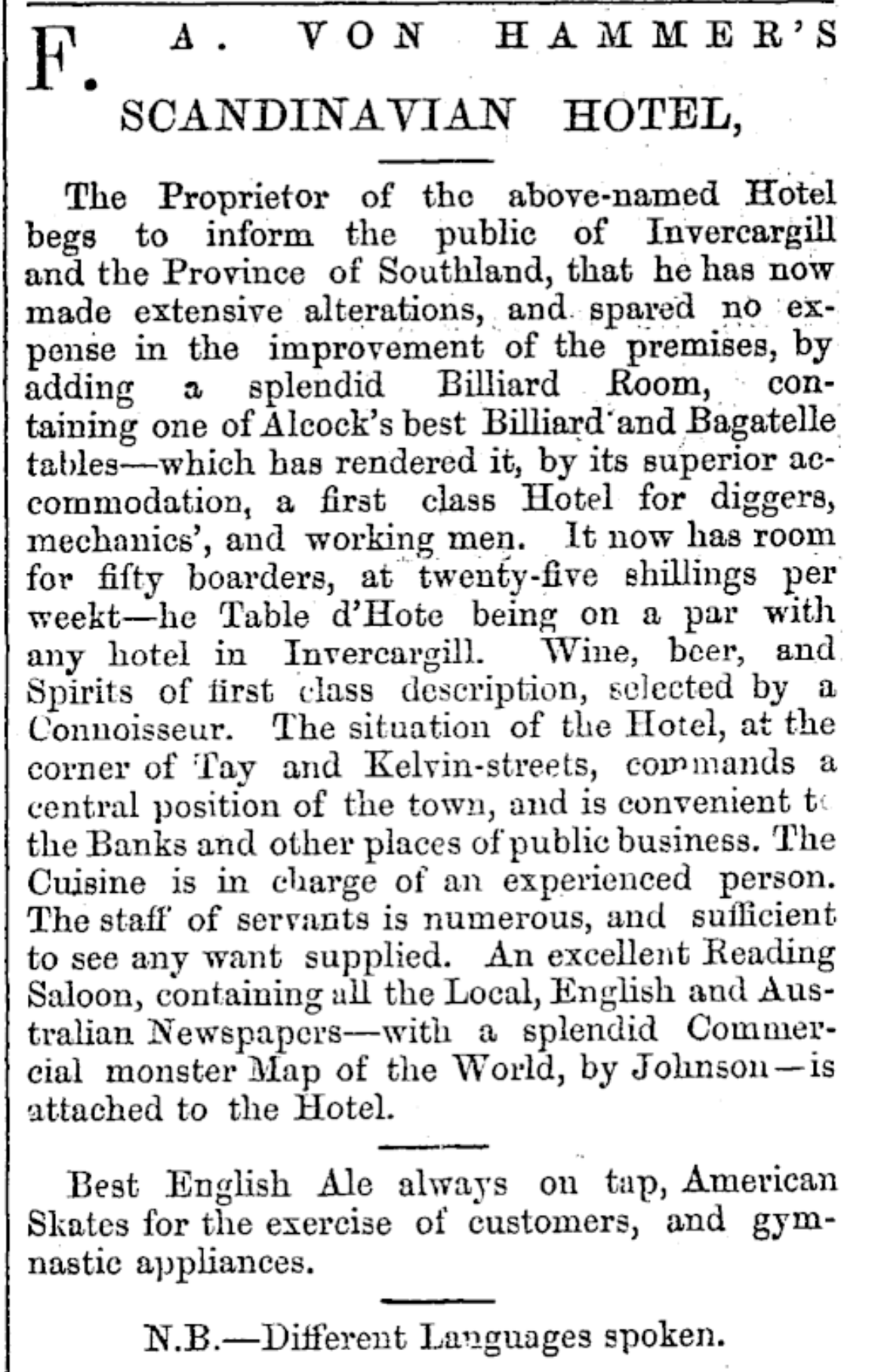
Papers Past; Southland Times, 7 October 1867, Page 4
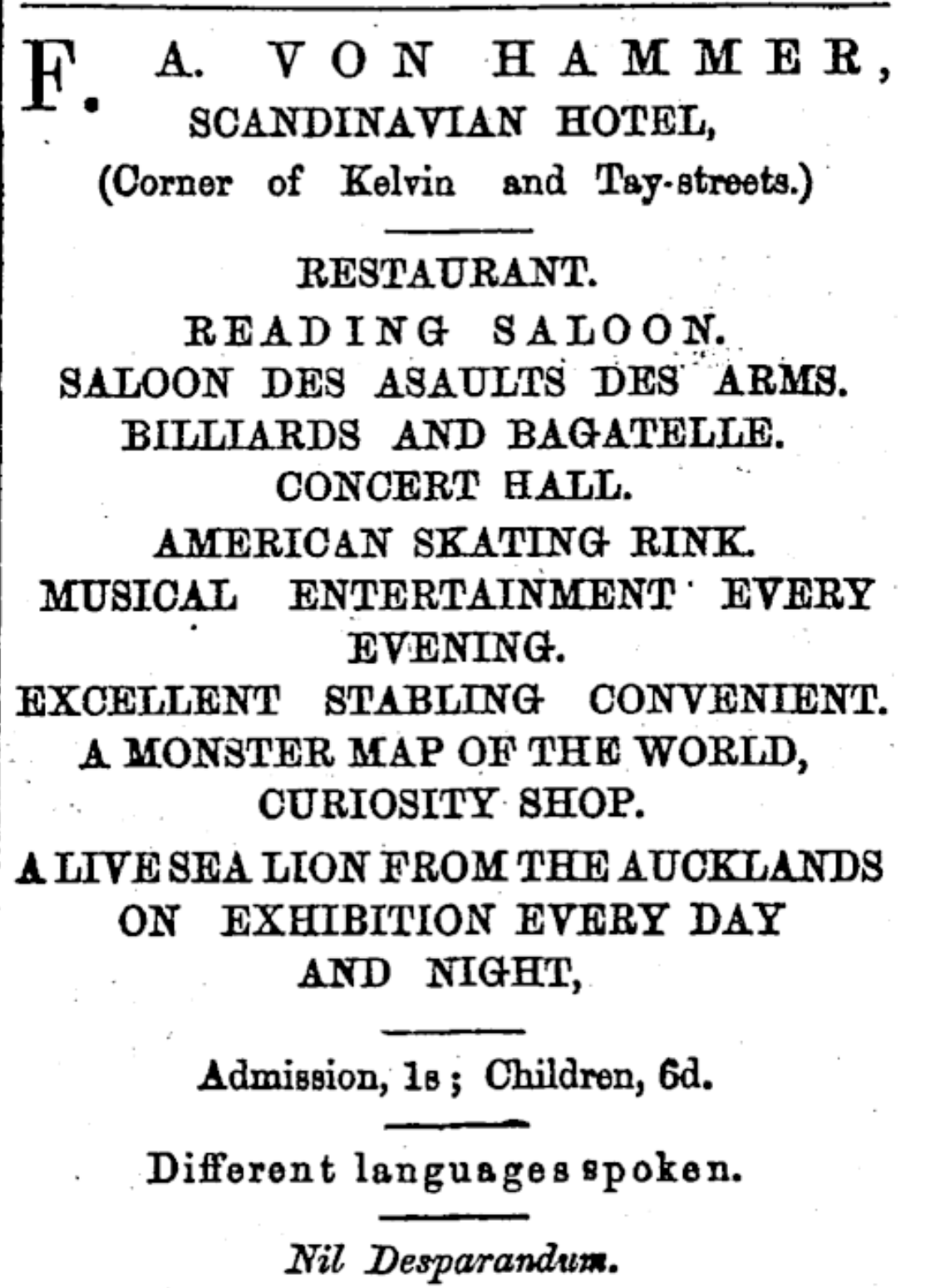
Papers Past; Southland Time, 16 March 1868, Page 3
The Scandinavian Hotel, 1866
In a Southland Times article dates 11 June 1866, Von Hammer announced that he had purchased “those large commodious premises at the corner of Kelvin and Tay Streets.” He intended to remodel them and, from 1 July 1866, rename the establishment the Scandinavian, after the famous Scandinavian Hotel in Dunedin. Advertisements proclaimed that it was “now open, a facsimile of that famous and popular hotel in Dunedin, called the Scandinavian.” He completed extensive alterations in 1867.
Most advertisements used the spelling “Scandinavian” with a “c”, although the name displayed on the building was clearly spelt with a “k”. The only advertisement I found using the “k” spelling was one seeking staff.
Von Hammer did not simply run a conventional hotel. He developed a combined accommodation, dining and entertainment complex.
· Hotel and restaurant
· Concert hall
· Billiards and bagatelle
· Musical entertainment every evening
· Gymnasium
· American skating rink
· Reading saloon
· Meals at all hours for 1 shilling and 6 pence
· Beds for 1 shilling
· Boxing gloves, singlesticks, rapiers and foils
The hotel reportedly accommodated 50 boarders. It also offered a billiard room, table d’hôte, and a reading saloon supplied with local, English and Australian newspapers. Other attractions included a large commercial map of the world, American skating equipment and gymnastic appliances. The hotel specifically marketed itself to “diggers, mechanics, and working men”, while many advertisements also promoted its “excellent stabling”.
A Live Sea Lion
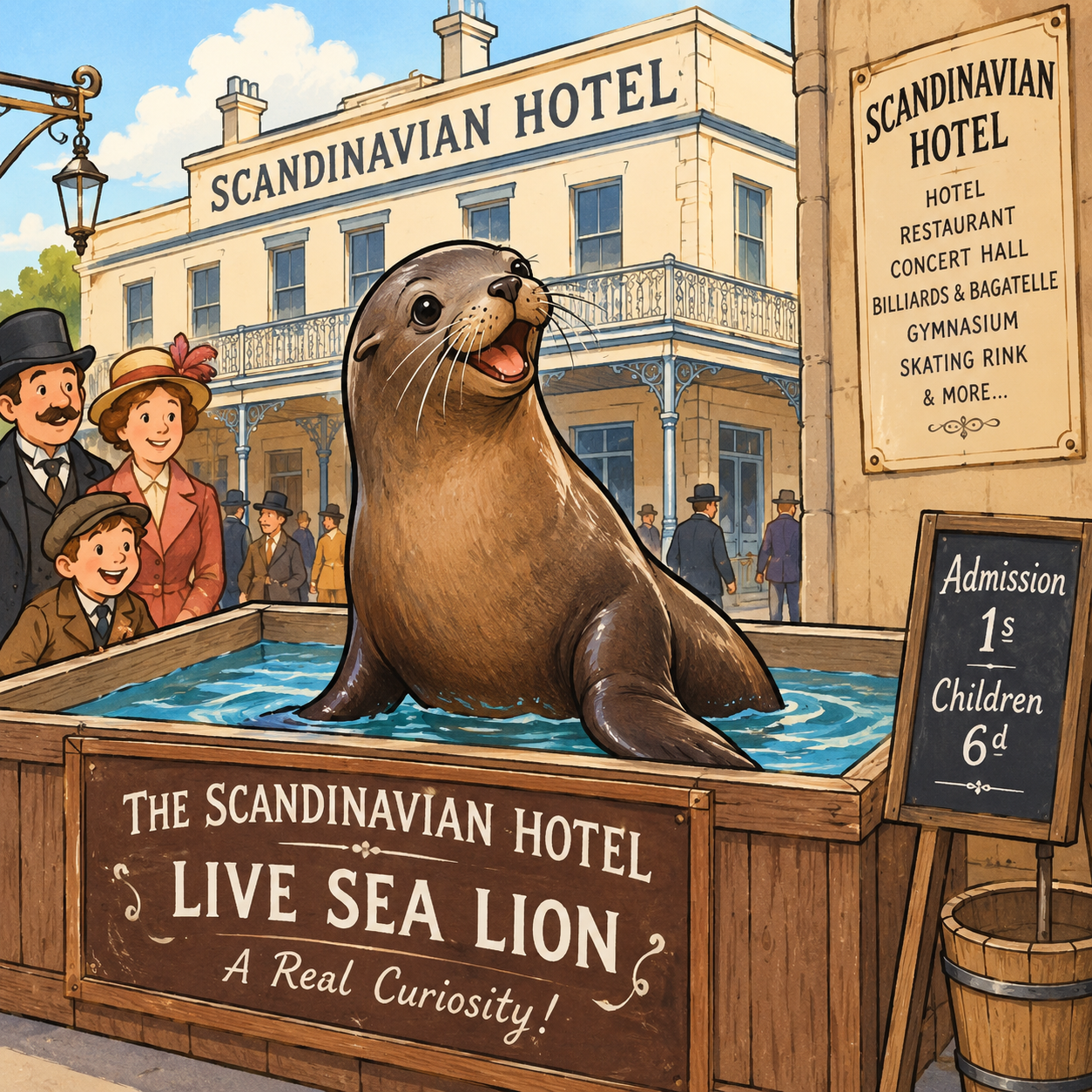
The Scandinavian also had a curiosity collection and even exhibited a live sea lion.
A report in the Southland Times, Issue 917, dated 16 March 1868, stated:
“The young seal brought over from the Auckland Islands by the Fanny, and subsequently procured by Mr Von Hammer as an interesting addition to his collection of curiosities at the Scandinavian Hotel, continues to live and thrive well. He enjoys immensely his swimming bath, but doesn’t at all like hot weather. He is now about three or four months old, and about the same size as a Newfoundland pup of the same age. His diet is entirely of fish, which is supplied to him in his tank, and, as his owner says, he can polish off a big cod in no time. The curious in natural history would find the animal well worth going to see.”
Admission was 1 shilling for adults and 6 pence for children.
The Scandinavian Concert Hall
An advertisement from November 1867 declared that Von Hammer:
“Wanted everybody to know that there is something else in Invercargill besides ‘Billiards and Beer.’ There is the Scandinavian Concert Hall, Tay Street, where you may hear Signor Robio and Mr Lloyd, and join in a Free and Easy.”
Hotel Cecil, 1899
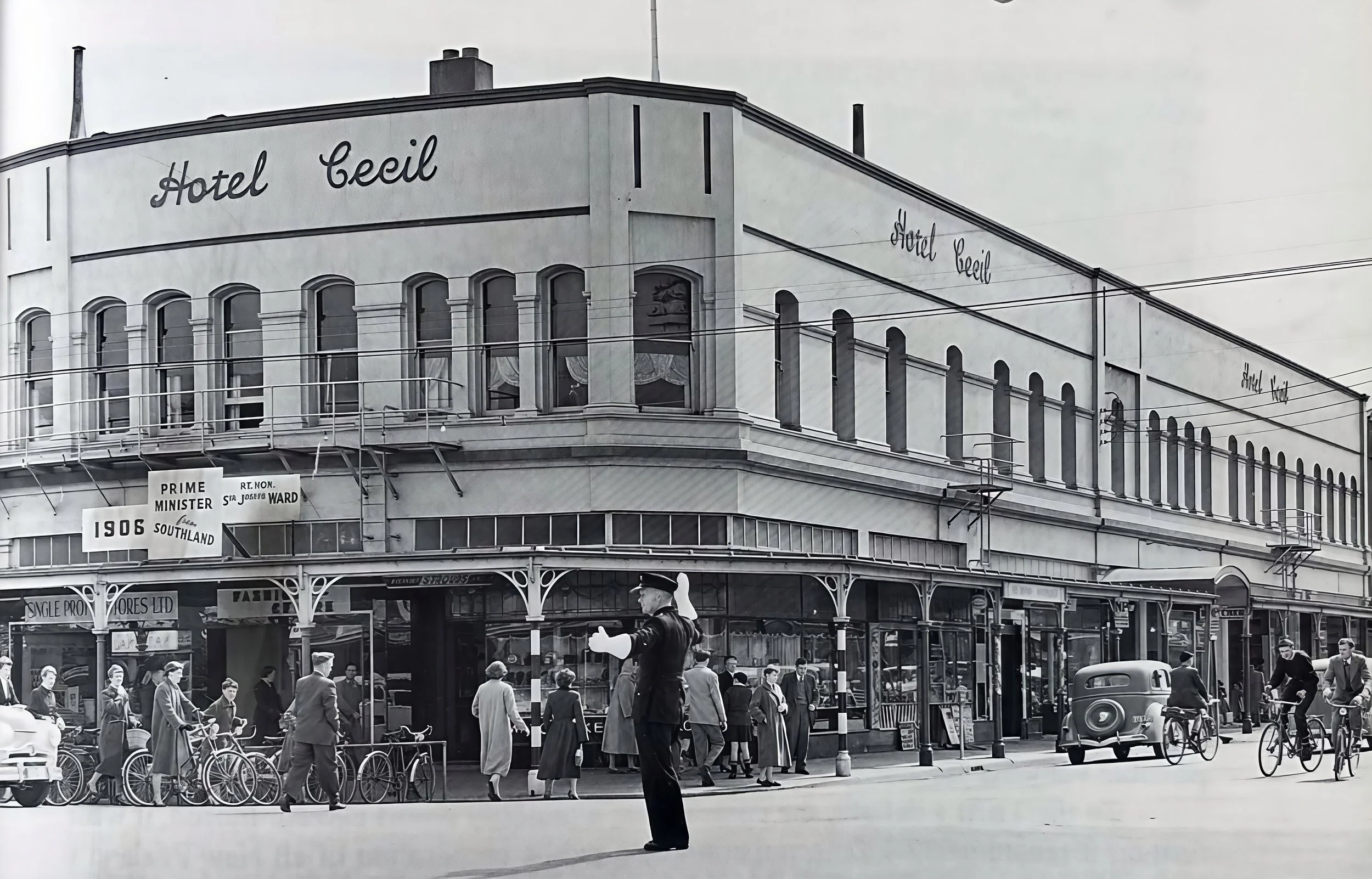
Sources indicate that the later building was constructed in 1899 and extended in 1913.
In 1911, an advertisement announced the Hotel Cecil was: “Now open for tourists and the travelling public. First-class accommodation. Fillery & Stroud, proprietors.”
In 1917, the Hotel Cecil, under a different proprietor, advertised:
· Accommodation for the travelling public
· A tariff of 7 shillings per day
· Accommodation for theatrical companies
· A commercial room
· A billiard room
· A sitting room
Its motto was “Civility, Attention, Cleanliness”, and the proprietor was James Fillery.
At some point, possibly around 1940, the hotel became the Hotel Milford, although the exact date has not yet been confirmed. According to Clive A. Lind’s Pubs, Pints and People: 50 Years of the Invercargill Licensing Trust, the Invercargill Licensing Trust took control of the Hotel Milford on 1 March 1945 and immediately renamed it the Cecil.
The Hotel Cecil closed in 1970, 25 years after the Invercargill Licensing Trust took control of the Hotel Milford and renamed it the Cecil.
Later Uses and Demolition
Many locals may remember the hotel. More recently, Foveaux Radio, was based upstairs in the former Hotel Cecil. The station began broadcasting from its extensively renovated and redecorated premises on Saturday, 2 May 1981.
The building was demolished during the block clearance for the modern Invercargill Central retail and commercial precinct. Before demolition, heritage recording identified original pressed-metal ceilings and decorative features.
Image: Hotel Cecil c .1906. Southland Museum & Art Gallery Niho o te Taniwha.
Fun Facts
Ingenious Awning Posts
In a Facebook post from November 2019, we shared a video clip showing an ingenious feature of the former Hotel Cecil on Kelvin Street. Its awning posts collected rainwater directly from the spouting, channelled it down through the hollow iron posts and discharged it into the gutters below.
A Secret Passageway
During demolition, a subterranean passageway was discovered. It reportedly allowed hotel staff to move around the building without disturbing guests.
A Personal Recollection
In her Southland Oral History interview, recorded in 2016, the much-loved Elizabeth Miller recalled working as a housemaid at the Hotel Cecil during school holidays.
Sources consulted for this developing history include contemporary advertisements and reports in the Southland Times, A. J. De La Mare’s Drink or Drought: Liquor Licensing and the Prohibition Movement, Clive A. Lind’s Pubs, Pints and People: 50 Years of the Invercargill Licensing Trust, Invercargill Library material, heritage records prepared before demolition, and Elizabeth Miller’s 2016 Southland Oral History interview.