
Southland’s Pioneer Nurses ~ Dr Sally Dobbs
Last year, Heritage South was privileged to have Dr Sally Dobbs join us as part of our Kōrero Series for Heritage Month in March 2025, and again for our encore event in September.
We’re sharing a couple of highlights from her presentations, along with a story about one of Southland’s Pioneer Nurses, Marion Sinclair Brown.
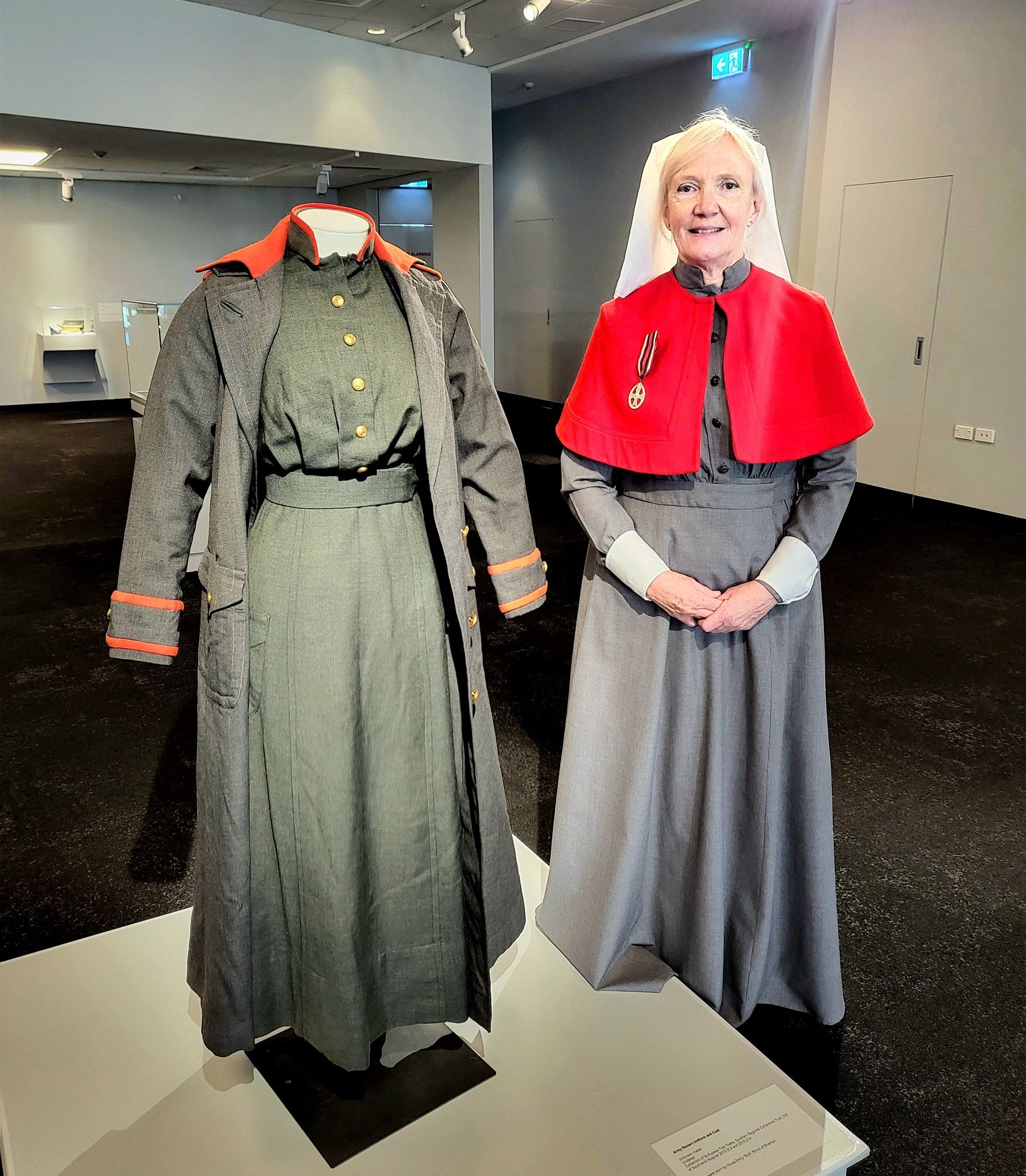
During Heritage Month 2025, Heritage South hosted an inspiring event at He Waka Tuia as part of their Stories of Southland series, titled "The Pioneering Nurses of Southland". We were honoured to have Dr. Sally Dobbs, a career nurse and former head of nursing at SIT, who talked about the brave and adventurous women who served as pioneering nurses during the late 19th and early 20th centuries.
Dr. Dobbs’ career spans many remarkable experiences, including her 16 years as an army nurse, primarily in nurse education. She wanted to be a soldier and, when qualified, joined the Queen Alexandra Royal Army Nursing Corps. She also spent six months as deputy matron in a field hospital in Bosnia. She left the British Army in 1999 and is a reservist nursing officer in the Royal NZ Nursing Corps. Her insights into the pivotal role these women played in times of conflict were both educational and deeply moving.
We were also thrilled to have Dr. Sally Dobbs pose beside a remarkable heirloom from the collection of Te Kupeka Tiaki Taoka, Southern Regional Collections Trust (image left)– an Army Nurse’s Uniform and Coat once worn by Nurse Emily 'Ruth' Rhind from Riverton. This item was generously gifted by the Southland Hospital in 2010, and was on display at He Waka Tuia’s Heirloom Exhibition.
Sally joined us again in September for our Stories of Southland, encore Kōrero event.
In November, Sally joined Senga on the Heritage South podcast to talk about Southland’s Pioneer Nurses, with a special focus on Marion Sinclair Brown. You’ll find a link to the episode at the bottom of this page.
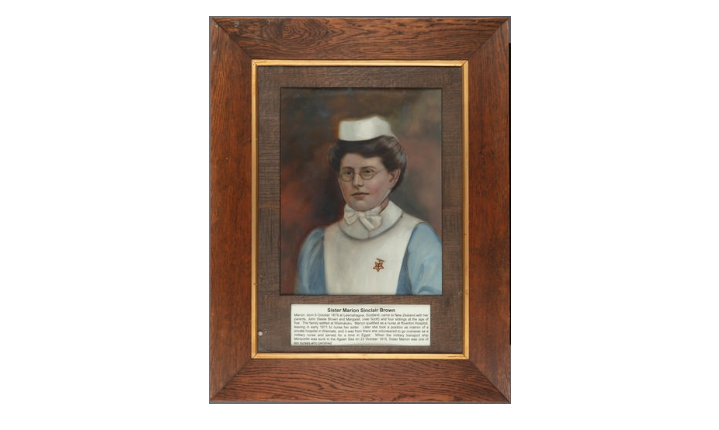
Marion Sinclair Brown
🩺 Marion Brown was born in Lesmahagow, Scotland (records vary between 1879 and 1880) and emigrated to New Zealand with her parents and siblings, settling in Waimatuku. She trained as a nurse at Riverton Hospital around 1908, later working in Palmerston North, Queenstown, and Waimate, where she became matron of Dr Barclay’s clinic.
In 1915, Marion enlisted as a military nurse, sailing on the Maheno to Egypt before boarding the Marquette for Salonika. The ship was torpedoed by a German submarine, and Marion was among 10 New Zealand nurses who lost their lives — the largest single loss of nurses in New Zealand’s history.
Her courage and compassion are remembered as part of Southland’s legacy of pioneer nurses who served with resilience and dedication during World War I.
***
🎧 Listen to the podcast to hear Sally share the full story of Marion Brown.
***
Image credit: Te Hikoi Museum, eHive collection (Object No. RI.FW2021.196).
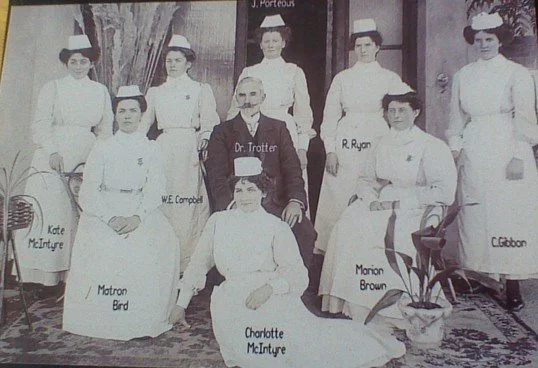
🏥 The Riverton Hospital Where Marion Trained
Wallace and Fiord Hospital was the main medical facility serving the western Southland district.
It was established in the late 19th century and rebuilt in 1887 on a prominent site overlooking the district and the Pacific Ocean.
The nurses in the photo — including Marion Brown, Kate McIntyre, W.E. Campbell, J. Porteous, Emily Rhind, C. Gibbon, Matron Bird, and Lottie McIntyre — all worked at this Riverton hospital.
Image kindly shared by Dr Sally Dobbs as part of her presentation.
🌿 Other Southland Nurses Who Served in World War I
Jessie McLeod
Trained as a nurse in Invercargill.
Served in Belgium during WWI, working with a surgeon near the Western Front.
Captured by German forces, treated both Allied and German wounded, and later escaped.
Joined the Queen Alexandra’s Imperial Military Nursing Service in the UK.
Managed a ward of 126 patients, and served in France and Italy.
Believed to have eventually returned to New Zealand.
Mary Frances Looney
Born in Winton, Southland.
Trained at Southland Hospital (Invercargill).
Served on the hospital ship Maheno and at the NZ Stationary Hospital in Cairo.
Survived the sinking of the SS Marquette in 1915.
Later served in France and England.
Awarded Associate of the Royal Red Cross.
There were undoubtedly other Southland women who served, if you have any further names, please let us know.
🌿 Southland Nurses in the Boer War
Doris Piper
One of seven Otago–Southland nurses who served in the Boer War.
Mentioned in Lord Kitchener’s dispatches — a rare honour, indicating exceptional service.
The specific act that earned her this recognition is not yet known.
🎙️A Final Reflection on Our Pioneer Nurses…
Before you go, we’d love you to take a moment to listen to the podcast — it brings these stories of our pioneer nurses to life in a way that words on a page can’t. Simply click on the button below..
✨ This was the closing reflection shared in the episode, taken from the Christchurch Star in November 1915:
“Those who scar the tree of life, a great thinker once said, are remembered by the scars; but those who water its roots have nothing by which they may be known — except the tree itself.”
It feels a fitting tribute to our pioneer nurses. They were the ones who watered the roots — sustaining their communities through quiet strength, compassion, and service. The trees that grew from their work still stand in the lives and wellbeing of generations that followed. ✨